The short answer
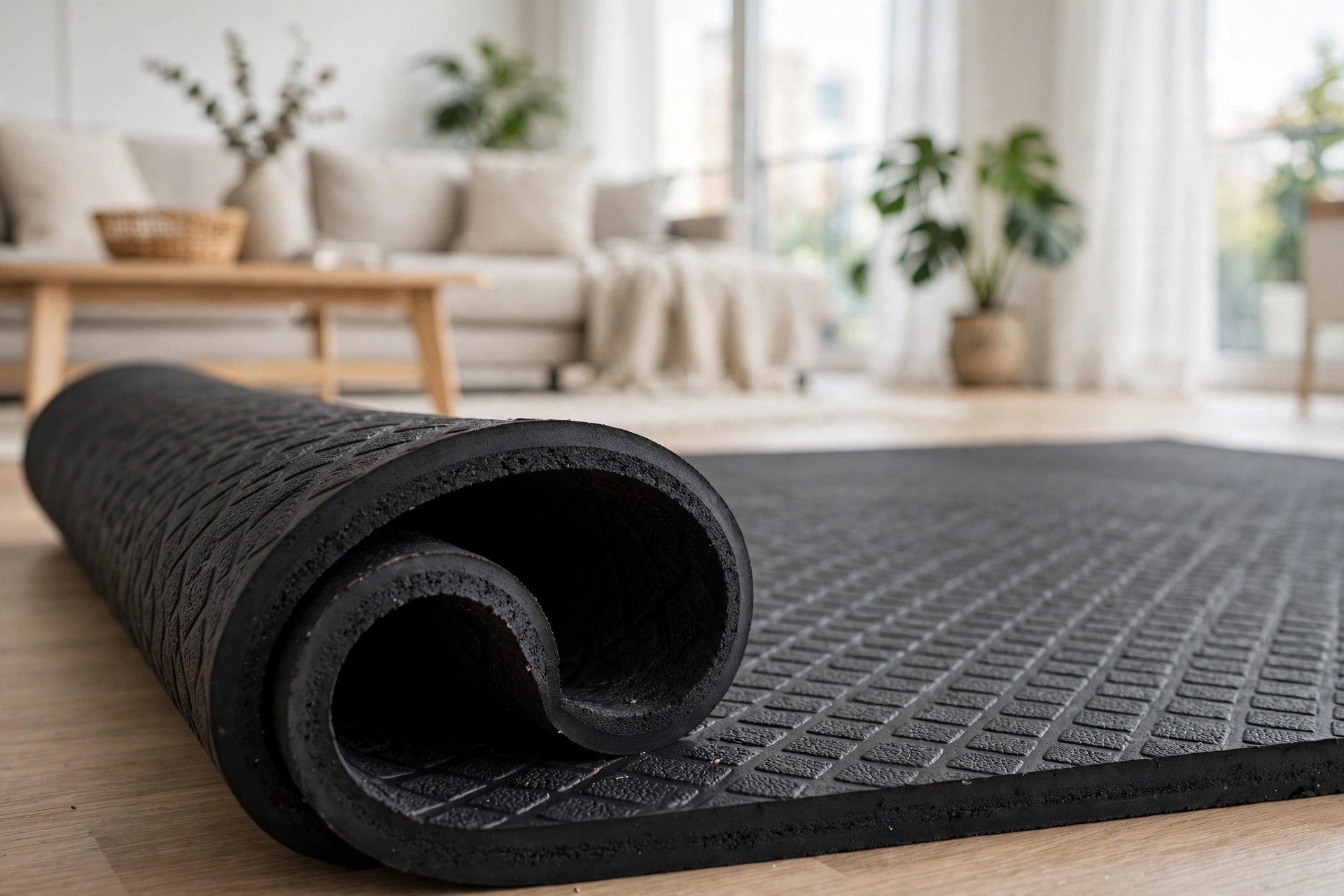
Buy a high-density rubber mat, 1/4 inch to 1/2 inch thick, sized to your machine's footprint plus 1 to 2 feet of margin on each side. That is the configuration with actual support behind it. A mat damps vibration traveling into the floor, protects the flooring from scratches, dents, and sweat, and keeps dust out of the machine. It does not soundproof the room, and it cannot eliminate footstep thuds on its own. Anyone promising a decibel reduction number for a mat is inventing it: no credible source publishes one.
This page is a dimension guide (material, thickness, size), not a ranked product roundup. It does not crown a single best mat.
What a mat can and cannot do
A mat's verified jobs, per manufacturer and reviewer sources: reduce vibration transmitted to the floor, protect floors from wear, and block dust from entering the machine. XTERRA's own mat page describes it as helping reduce noise and dampen vibrations while protecting floors from wear and tear.
What it cannot do: eliminate all noise. As one acoustic guide puts it, no mat eliminates all noise, though a good one creates a more peaceful environment. The remaining sound is mostly structure-borne thud from foot strikes, which a surface mat can reduce but not remove. Plan the mat as one layer alongside placement, isolation feet, maintenance, and training hours, covered in the noise reduction playbook.
Thickness: the honest range
Sources do not agree on one ideal thickness, so this site will not invent one. The documented positions:
- 1/4 inch (6 mm): the baseline. Equipment reviewers describe 6 mm as where a decent mat starts, and anything thinner gives minimal protection against noise and vibration. XTERRA's own treadmill mat is 6 mm.
- 3/8 inch: the upstairs recommendation. FlooringInc's official FAQ, answering a second-floor apartment question directly, recommends a 3/8-inch equipment mat for reducing noise and vibration.
- 1/2 inch: the heavy-duty position. Apartment-focused guides recommend at least 1/2 inch of high-density rubber for upstairs use, noting that standard thin mats around 3/16 or 1/8 inch protect the floor but do little for vibration.
The pattern across sources: thicker helps, but only when the density is there. Buy inside the 1/4 to 1/2 inch range, choose dense over merely thick, and treat upstairs setups as the case for the thicker end.
Thick but low-density is the trap. Cheap thick pads feel soft, damp little vibration, and can let the treadmill frame flex and feel unstable. Density first, thickness second.
Material: rubber vs PVC vs EVA
| Rubber | PVC | EVA foam | |
|---|---|---|---|
| Density and durability | Dense and durable; the standard for vibration damping | Varies widely; cheap PVC wears fast | Light and soft; poor long-term durability |
| Odor | Recycled rubber can smell at first | Often has a chemical smell on unboxing | Usually low odor |
| Weight and handling | Heavy; stays put | Light; easy to move | Very light; puzzle tiles can separate with use |
| Water | Fine with sweat; wipe clean | Wipe clean | Can get slippery when wet |
The cross-source picture: rubber is consistently described as denser and more durable. Multiple reviewers note that cheap PVC pads wear out quickly and often arrive with a strong volatile smell, with one major review site reporting a chemical odor from a popular PVC mat on unboxing. EVA foam is light and cheap, but reviewers report puzzle-style EVA tiles coming apart over time and getting slippery when wet. That said, the criticism targets cheap thin PVC specifically; some buying guides describe high-density PVC as durable. The fair summary is not "PVC is always bad" but "cheap thin PVC is a poor buy for vibration damping," and not "rubber has no smell" but "recycled rubber can smell at first."
Size: measure, then add margin
Documented common sizes: 3' x 7' (XTERRA's official mat), 36" x 90", 36" x 72", 36" x 84", 4' x 6.5' and 4' x 7.5' (Rubber-Cal's 3/16-inch rubber), and walking-pad mats around 30" x 60".
The sizing rule is consistent across sources: measure the machine's footprint first, then add 1 to 2 feet of margin on each side. The margin catches sweat and debris, gives you safe footing space, and keeps the mat's edge away from the belt path. For a full-size folding treadmill with a 20" x 60" deck on a roughly 35" x 75" frame, a 3' x 7' or 4' x 7' mat is the natural fit. For a walking pad, a 30" x 60" mat covers the unit with margin to spare.
Walking pad vs full treadmill mats
The physics is the same, the scale differs. Full treadmills need full-size mats in the sizes above. Walking pads work with smaller mats, and their lower weight and lower speeds mean a 1/4-inch dense mat is a reasonable baseline rather than a compromise. Whatever the machine, the mat goes under the entire unit including the feet, not just under the belt area.
Unboxing, care, and the curled edge
- Flattening. Some mats arrive rolled and need weights to press them flat before use; reviewers note this for several popular mats, while others arrive flat out of the box. Budget a day of flattening for roll-packed mats.
- Cleaning. Wipe with a damp cloth and soapy water. No special cleaner is needed, and the surface is waterproof. That guidance is consistent across reviewer sources.
- Curled edges are a trip hazard. A mat that will not lie flat at the edges is a safety problem, not just a cosmetic one. If weights and time do not flatten it, replace it.
Put the grippy or textured side down, against the floor. Adding a slip-resistant layer on top of the mat, between the mat and the machine, can hurt stability according to acoustic guides.
Set the right expectation
A good mat plus isolation feet plus sensible placement is the realistic ceiling for a home setup, and even that ceiling has a limit: structure-borne thuds do not fully disappear. Judge the mat on what it verifiably does (less vibration into the floor, a protected floor, a cleaner machine), not on silence it cannot deliver.