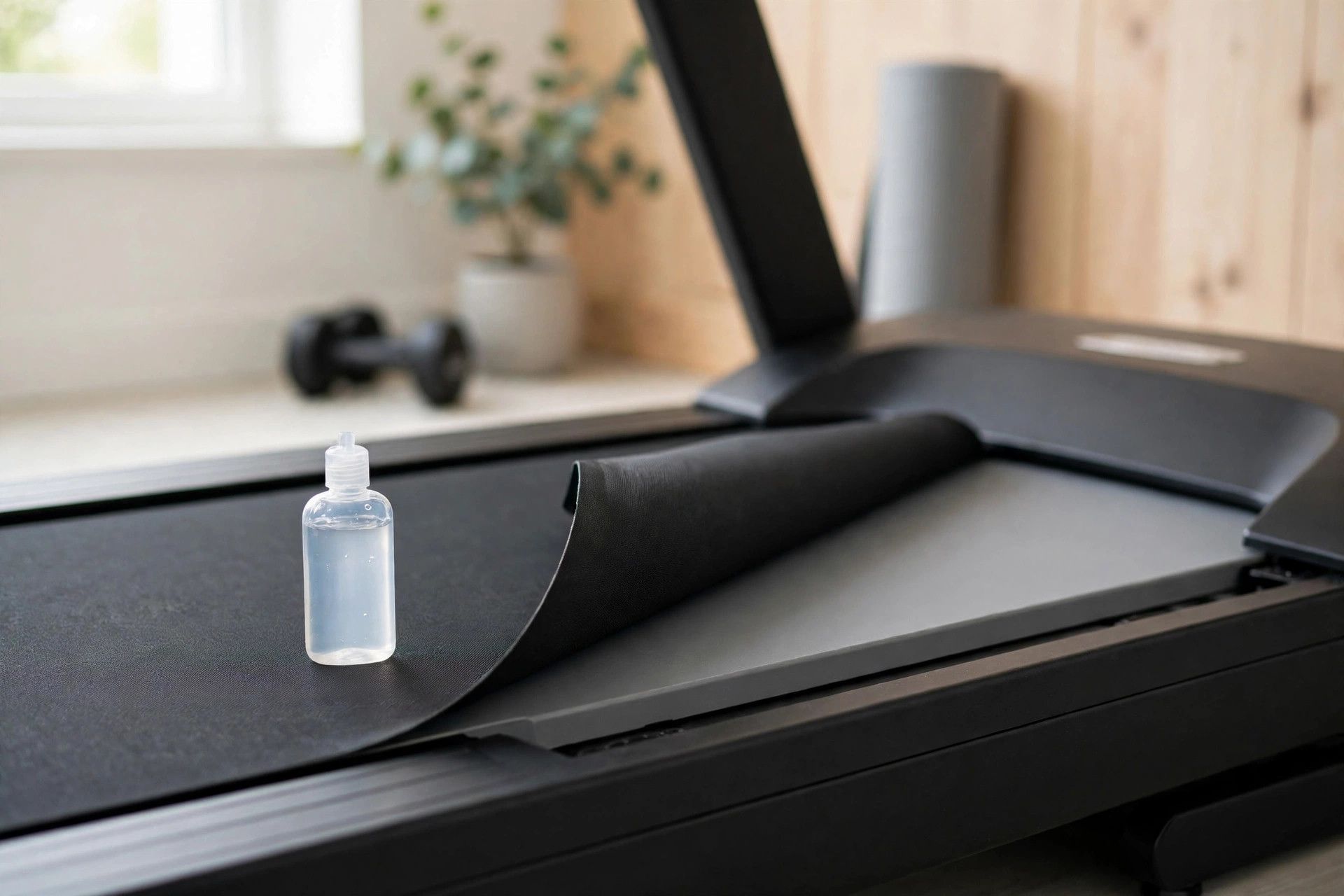
The short answer
Lubricate the belt on your manufacturer's schedule, with 100 percent non-petroleum silicone lubricant, and nothing else. There is no universal schedule: LifeSpan says every 3 months or 50 hours, Horizon says every 6 months or 150 miles, Sole says every 90 hours, WalkingPad says every 3 months, and UREVO splits by model. Some belts are maintenance-free and must not be lubricated at all. Check your manual first, because the wrong lubricant or the wrong schedule can damage the machine or void coverage. Never use WD-40, petroleum products, household oils, or aerosol silicone sprays on the belt.
First: does your belt even need lubricant?
Not all of them do. LifeSpan's TR5000B ships with a maintenance-free belt that the manual says does not require lubrication. Many brands ship belts pre-lubricated from the factory, including Sole, LifeSpan, UREVO, and WalkingPad models. And one brand is the explicit exception: older NordicTrack machines with Performant Lube pre-coated belts carry a manual warning never to apply silicone spray or other substances to the belt or deck, because it deteriorates the belt. Modern NordicTrack guidance is only available through third-party summaries (roughly every 3 to 6 months with 100 percent silicone), so NordicTrack owners must check their specific model-year manual rather than borrowing another brand's rule.
The working default from equipment guides: if your manual does not explicitly describe a maintenance-free belt, the belt needs periodic lubrication.
What to use and what never to touch
Use: 100 percent silicone lubricant with no petroleum content. Brand manuals specify it consistently: LifeSpan, Horizon (1000-viscosity silicone in its service document), Sole (Sole-approved lubricant), UREVO (non-petroleum silicone), and WalkingPad (100 percent silicone).
Never use: WD-40, 3-in-1 oil, white lithium grease, household oils, petroleum-based products, or aerosol silicone sprays. LifeSpan's manual explicitly warns that aerosol silicone sprays contain additives and petroleum distillates that damage the machine, and Johnson Fitness's troubleshooting guide states that petroleum-based products will damage the equipment. One minority source suggests a silicone WD-40 variant for rollers, but the near-unanimous manufacturer position is against it, and this site follows the manufacturers.
Brand schedules (each attributed, none universal)
| Brand | Schedule | Amount | Source |
|---|---|---|---|
| LifeSpan | Every 3 months (even unused; silicone evaporates) or 50 hours, whichever first | About 1 oz total (about 1/2 oz per side, applied under the belt near the middle) | TR3000i / TR1200B manuals |
| Horizon | Every 6 months or 150 miles; console shows LUBE / LUBE BELT at 150 miles | One full 40–50 ml bottle per Horizon's service document | T71/T72, T101, T93 manuals; Johnson Fitness service doc |
| Sole | Every 90 hours of use or when the deck feels dry; check every 2 months by hand; Lube light at 90 hours | S-pattern about 1/8" wide x 15" long, 4–6" from one edge, both sides | Sole manual |
| UREVO 2-in-1 (UR9TM0011) | Every 3 months or 100 miles | About 10 ml through the lube port; run 0.6 mph about 3 minutes, then clear the lube LED | UR9TM0011 manual |
| UREVO folding (UR9TM0010 / URTM012) | After 1 year or 100 hours of running; check every 30 days / 30 hours by lifting the belt and feeling the deck | 10 ml when dry | UR9TM0010 / URTM012 manuals |
| WalkingPad / KingSmith (TRR2F, TRX21F) | Every 3 months | 5–10 ml silicone; over-lubrication causes slipping | TRR2F / TRX21F manuals |
| WalkingPad N1 | Before first use; then every 25 hours or 3 months, whichever first | About 15 ml through the lube port; slow speed 3–5 minutes to distribute | N1 manual |
Note the Sole correction: third parties often attribute "every 3 months or 150 miles" to Sole, but the verified Sole manual specifies 90 hours. Attribute the schedule to the manual, not the forum.
Step by step: Horizon's official method
This is the most detailed manufacturer procedure on record, from Johnson Fitness / Horizon's service document. Adapt the specifics to your brand's manual.
- Power off and unplug the machine. Every manual requires this; never lubricate with the belt powered.
- Loosen the two rear roller bolts counterclockwise, 10 to 12 turns.
- Lift the belt and apply 100 percent silicone (1000 viscosity) in a zigzag covering the whole deck. Do not apply it to the belt itself. Use the full 40 to 50 ml bottle.
- Re-tighten the bolts the same number of turns.
- Power on, run 3 minutes, then walk 3 minutes to distribute the lubricant.
- Wipe excess from the belt edges and side rails with a damp cloth.
Simpler variants exist: LifeSpan has you apply from the front (motor end) by hand under the belt, both sides, then run 3 mph for 3 minutes with no load. WalkingPad's method is to lift the belt edge, apply silicone to the inner surface, and run 3 km/h for 10 to 20 seconds. Follow whichever matches your manual.
Signs your belt is dry
Friction increase, squeaking or squealing, the belt hesitating, sticking, or slipping, the motor sounding strained, the belt feeling hot, or the deck underside feeling dry and waxless when you lift the belt and touch it. WalkingPad's N1 manual states the diagnostic plainly: squeaking or squealing often indicates a need for lubrication. Address it early; a dry belt wears both the belt and the deck faster and gets louder the longer it runs dry.
More is not better. Multiple manuals warn that over-lubrication causes the belt to slip. Use your brand's specified amount and wipe away the excess.
Belt centering and tension
A belt that drifts or slips adds noise and wear. From WalkingPad's N1 manual: if the belt drifts right, turn the right rear roller bolt a quarter turn clockwise (mirror for left drift), run a minute, and reassess. If the belt slips, turn both rear bolts a quarter turn clockwise. The belt should lift 5 to 7 cm off the deck when pulled up at the middle. Do not over-tighten: UREVO's manuals warn that an over-tight belt damages the belt and roller bearings and creates noise of its own.
Cleaning routine
Wipe the machine after each use and keep it clean and dry. Mild cleaners handle sweat and salt; do not pour cleaner directly on the belt and avoid acidic or corrosive cleaners. Vacuum under the belt and around the motor area on a schedule, and clean the deck before applying lubricant so you are not sealing dust under the oil film.