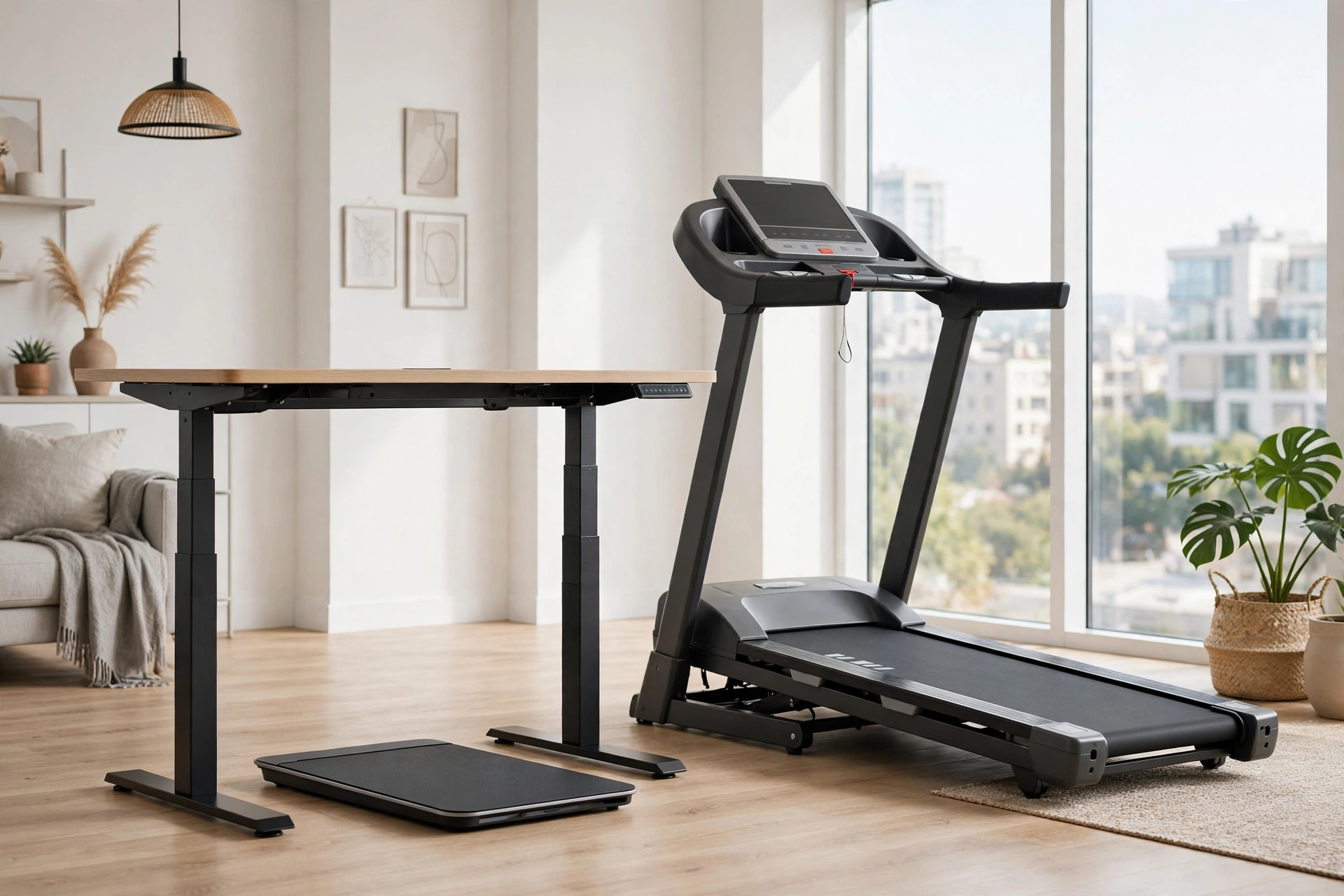
The short answer
Walking pads are quieter by design. BarBend's FAQ gives the mechanism: walking pads use smaller motors, have fewer moving parts, and draw less power than full treadmills. Walking itself is quieter than running because each running stride hits the deck harder, and harder impacts produce more vibration, which produces more sound.
That is the honest limit of the claim. No independent test has measured a walking pad and a full treadmill with the same method, so there is no head-to-head decibel winner. The numbers that exist look confusing at first glance: Tom's Guide measured an average 57.3 dB for the WalkingPad Z1, while BarBend measured 34.7 to 37.4 dB for full-size machines. Those figures come from completely different methods (an app-based average reading vs a one-foot isolated measurement with room noise subtracted), so they cannot be used to argue that full treadmills are quieter. Choose between the two categories by how you train, how much space you have, and what you can carry upstairs, not by comparing decibel figures across sources.
The noise question, answered carefully
Two separate facts get mixed up in this debate. First, the machine category: BarBend's FAQ states that walking pads are quieter than treadmills as a category, for the mechanical reasons above. Second, the activity: walking is quieter than running on any machine, because impact force drives vibration and vibration drives sound.
The available measurements:
- WalkingPad Z1: average 57.3 dB, measured by Tom's Guide reviewer Ashley Thieme with the DecibelX app. The product description claimed below 45 dB. Both are on the record; one is a third-party average, the other is the manufacturer's claim.
- Full-size machines: 34.7 dB (Horizon 7.0 AT), 35.4 dB (Sole F80, older model), 36.3 dB (NordicTrack 1750, 2023 model), 37.4 dB (ProForm Carbon TLX), all from BarBend's test with the tester one foot away at top speed after subtracting ambient room noise of 35 to 38 dB.
- Manufacturer claims for walking pads: UREVO lists about 35 dB for the CyberPad for Office under specified test conditions. WalkingPad lists under 65 dB for the X21. DeerRun's UK site lists 45 dB or less for the A1 Pro Move+. The WalkingPad P1 and DeerRun Q2 make no numeric claim.
Do not line these numbers up in one ranking. The only valid noise comparison on this page is structural: smaller motor plus fewer parts plus lower power plus walking instead of running equals less sound to begin with.
If noise is your top concern and you only walk, start with the walking pad category. If you run, pick the quietest-tested full-size machine and spend the savings on a dense mat and isolation feet.
Side-by-side specifications
All specs and prices are from the official product pages, checked 2026-10-02.
| WalkingPad P1 | WalkingPad X21 | UREVO CyberPad for Office | DeerRun Q2 Urban | Horizon 7.0 AT | Sole F80 (2026) | |
|---|---|---|---|---|---|---|
| Top speed | 0.3–3.75 mph | 1–7.5 mph | 0.6–4 mph | 0.6–3.8 mph | 0.5–12 mph | 0.5–12 mph |
| Belt | 47" x 16.5" | 47.6" x 18.1" | 39.4" x 16.5" | Not listed | 20" x 60" | 20" x 60" |
| Folded / stored size | 32.5" x 21.5" x 5" | 39.6" x 27.9" x 8.8" | 42.9" x 22.8" x 6.3" (flat) | 45" x 20" x 4.5" (flat) | 44" x 35" x 68" | 48" x 36" x 66" |
| Weight | 62 lb | 81 lb | 63.1 lb | 41 lb | 277 lb | 218 lb |
| Capacity | 220 lb | 240 lb | 400 lb | 300 lb | 325 lb | 350 lb |
| Incline | None | None | 0–14% auto | 7% | 0–15% | 0–15% powered |
| Noise data | No official claim | Under 65 dB (official) | About 35 dB (official, specified conditions) | No official claim | 34.7 dB (BarBend) | 35.4 dB (BarBend, older F80) |
| Listed price | $349 | $799 | $479.99 | $119 | $1,099 | $1,599.99 |
Space: the real difference
A walking pad disappears. The P1 folds to 5 inches high and slides under a sofa or bed. The Q2 is 4.5 inches tall as a flat unit. The CyberPad for Office is 6.3 inches tall and stands upright in a closet. The X21 double-folds to 39.6" x 27.9" x 8.8" and stores vertically.
A full treadmill needs a permanent spot. The 7.0 AT folds to 44" x 35" x 68" and weighs 277 lb. The F80 folds to 48" x 36" x 66" at 218 lb. Hydraulic folding (FeatherLight on the Horizon, Kick Release on the Sole) makes folding easier, but it does not make a 277 lb machine light to move. If you live upstairs or need to carry the machine through a narrow hallway, that weight difference decides the purchase before noise does.
Speed and training use
Walking pads in the classic sense top out at 3.75 to 4 mph, which covers walking and light walking workouts. Two models break the mold: the WalkingPad X21 runs 1 to 7.5 mph and the DeerRun A1 Pro Move+ runs 0.6 to 10 mph, so both handle jogging and light running. The UREVO Strol 2S Pro splits the difference with walk mode at 0.6 to 4 mph and run mode at 0.6 to 7.6 mph, though it is currently pre-order with estimated delivery 2026-10-15.
Full-size machines run 0.5 to 12 mph on 20" x 60" decks with powered incline to 15 percent. If your training includes tempo runs or interval work, the walking pad category cannot replace that. If your training is daily steps at a desk, a full treadmill is capacity you will never use.
Price bands
Using official-site listed prices checked 2026-10-02: walking pads run $119 (DeerRun Q2) to $799 (WalkingPad X21), with the P1 at $349 and the two UREVO CyberPads at $399.99 and $479.99. Full-size folding machines run $1,099 (Horizon 7.0 AT) to $1,599.99 (Sole F80). The price gap is real, and so is the capability gap. The budget breakdown lives in quiet treadmills under $500.
Who should buy which
Pick a walking pad if: you walk rather than run; the machine must fit under a desk or bed; you need to carry it yourself (41 to 81 lb); you live upstairs and want the lightest, lowest-impact option; your budget is under $500.
Pick a full treadmill if: you run or plan to; you want powered incline and a full-length deck; the machine gets a dedicated spot; you can handle 200-plus lb for delivery and setup.
Look at the hybrids if: you want one machine for both. The X21, A1 Pro Move+, MERACH T12 Pro, and Strol 2S Pro fold small like walking pads and reach jogging speeds. Their belts are shorter and narrower than full decks (17.7" x 47.3" on the T12 Pro, for example), which is the trade they make for the footprint.