The short answer
Treadmill noise comes from three places: the motor, the impact of your feet, and vibration traveling from the machine into the wall and floor. That three-source breakdown comes from WalkingPad's own apartment guide, and it dictates the fix: no single product solves all three. The working playbook is a dense rubber mat plus isolation feet for vibration, placement away from shared walls, regular belt lubrication and tightened hardware for mechanical noise, walking instead of running when it matters, and daytime training hours. What no source supports: any mat or accessory with a specific decibel reduction claim, and any method that makes a treadmill fully silent. Every credible source agrees that is impossible in an apartment.
Know your three noise sources
- Motor hum. Constant, airborne, and the easiest to live with. Smaller motors on walking pads generate less of it. Brushless motors are marketed as quieter, but no tested source on this site quantifies the difference, so treat it as a design note rather than a number.
- Footstep impact. The loud part. BarBend's FAQ states the physics plainly: sound is produced when force is applied to an object and makes it vibrate, and running applies more force per stride than walking. This is the thud your downstairs neighbor hears.
- Structure-borne vibration. The machine shakes, the floor carries it. An acoustic consultant quoted in a structural engineering interview put it directly: noise from exercise equipment is transmitted through the structure itself. This path is why a mat helps but never finishes the job.
The mat: your highest-value purchase
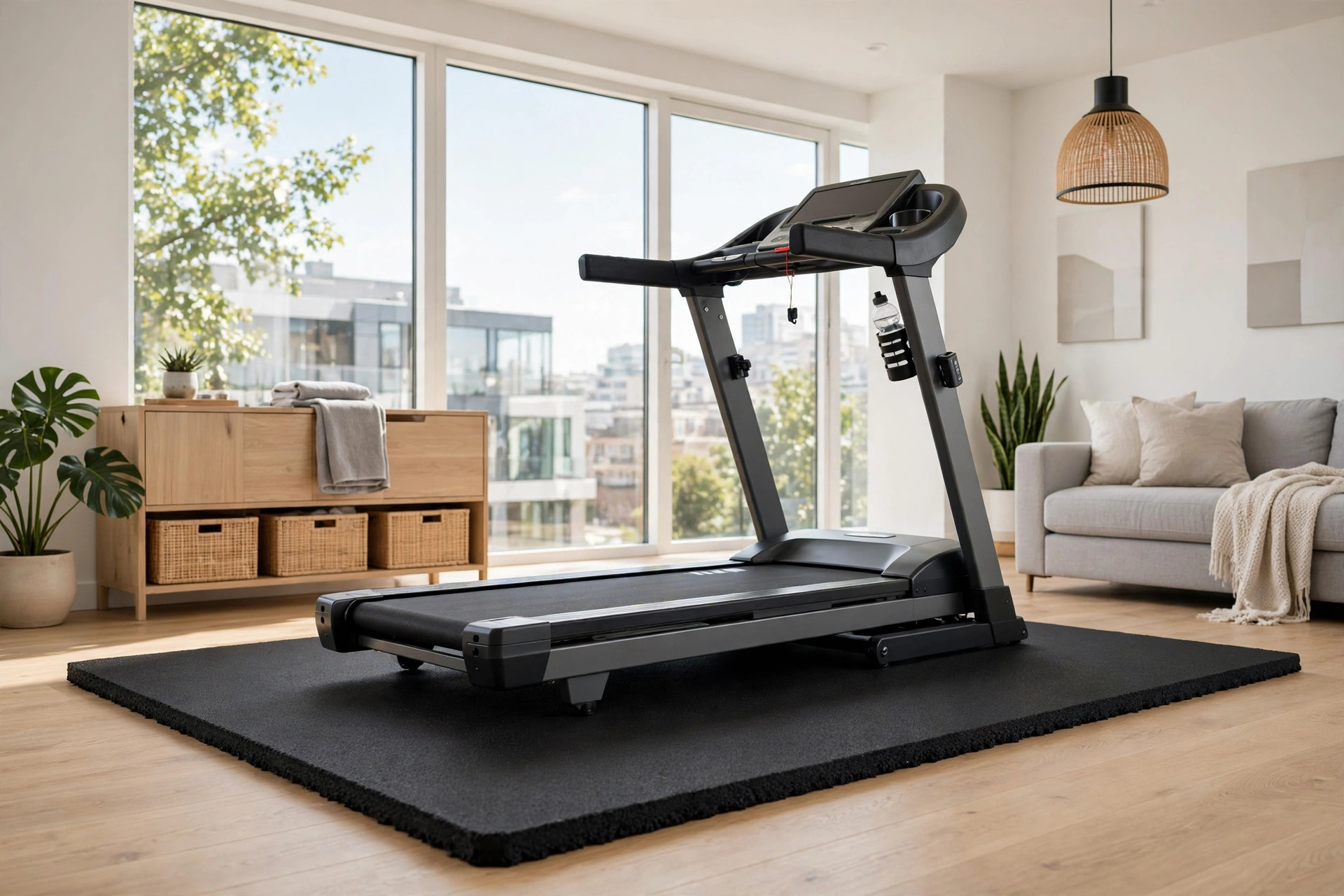
Multiple noise-focused sources call a high-density rubber mat the most effective single step. Rubber absorbs impact and spreads vibration over a larger area. What counts as enough:
- About 1/4 inch (6 mm) of dense rubber is the common baseline for a decent mat. Anything thinner gives minimal protection against noise and vibration, per equipment reviewers.
- For upstairs use, FlooringInc's official FAQ recommends a 3/8-inch equipment mat, while other guides recommend at least 1/2 inch of high-density rubber.
- Standard 3/16-inch mats give basic floor protection against scratches and dents but do little for vibration damping.
Density matters more than thickness. A cheap thick pad with low density feels soft, does little for vibration, and can make the treadmill frame flex and feel unstable. The full selection logic is in the treadmill mat guide.
No credible source quantifies how many decibels a mat removes. Any product or article promising a specific dB reduction is making a number up. Expect "less," not a figure.
Isolation feet: the second layer
Purpose-built isolation feet sit under the treadmill's existing feet and decouple the frame from the floor. Documented examples include 4" x 4" x 7/8" rubber-and-cork pads and Pliteq's paired system with 18" x 5" front pads and 5" x 7" rear pads. They stack with a full-size mat rather than replacing it: mat for broad damping, feet for point decoupling. Several guides describe layered setups (rubber mat, then EVA, then a rigid board to spread the load) as more effective than any single layer, though no tested source gives the combination a measured value.
Placement beats products
Where the machine sits changes what the neighbors hear:
- Keep it away from shared walls and walls shared with bedrooms. WalkingPad's apartment guide and legal guides agree on this.
- Upstairs placement is the hardest case. The small noise and movement you feel at the machine gets amplified as it passes through the flooring, and multiple guides describe the second floor as possible but not recommended.
- Put it in a corner or near a load-bearing wall rather than the middle of the room, where floor deflection and vibration are strongest.
- Never above the downstairs neighbor's bedroom if you can avoid it.
The complete upstairs protocol is in the upstairs apartment checklist.
Maintenance: the noise that creeps in
A treadmill gets louder as it wears. The fixes are unglamorous and they work:
- Lubricate the belt on the manufacturer's schedule. LifeSpan specifies 100 percent silicone oil, about one ounce, every 3 months or 50 hours, whichever comes first, and explicitly bans aerosol silicone sprays with additives. Horizon specifies every 6 months or 150 miles with the supplied lubricant. Sole specifies every 90 hours or when the deck feels dry. Cycles differ by brand, so check your manual. Never use WD-40, petroleum products, or household oils on the belt. The full brand-by-brand reference is in the belt lubrication guide.
- Tighten what loosens. Loose frame bolts and a dry belt are among the most common new-noise causes. Check the hardware periodically and re-center a drifting belt with quarter-turn adjustments to the rear roller bolts.
- Keep it clean. Dust under the belt and around the motor area adds friction and noise. Wipe the machine after use and vacuum the belt underside and motor compartment on a schedule.
Walk when it matters
When noise is the constraint, walking instead of running is the single biggest lever you control. The impact difference is not subtle: running multiplies the force of each foot strike, and that force becomes the thud below. Several apartment guides state it as a standing rule for upstairs use. If your training plan needs running, schedule those sessions for daytime hours and keep the mat and feet in place regardless.
Soft furnishings: limited help
Fabric wall hangings, acoustic panels, and thick rugs absorb reflected airborne sound inside your room. They do not stop vibration traveling through the floor into the apartment below. Treat them as comfort upgrades for your own space, not as neighbor protection.
Timing, lease, and landlord
- Train during the day and avoid early mornings and late nights. Typical quiet hours run 10 pm to 7 am on weekdays and 11 pm to 8 am on weekends and holidays, but those are typical values, not universal rules. Check your lease and local ordinances for your building's actual hours.
- Check the lease before the machine arrives. Look for clauses on heavy equipment, noise, and vibration, and get the landlord's approval in writing if there is any doubt.
- Tell the downstairs neighbor your plan before the first workout. The neighbor strategy is covered in treadmill neighbor etiquette.
Two sources disagree on carpet versus hard flooring, and two disagree on morning versus daytime training. The stable, well-sourced position: a dense rubber mat on the floor you have, training during daytime hours, and your lease as the authority on timing.
What you cannot fix
No treadmill can be completely silent, and no combination of accessories eliminates structure-borne thuds entirely. Set expectations with that ceiling in mind: the goal is a setup your neighbors can live with, not a number on a meter.